
8 Best Websites to Sell Stuff Online
Last updated November 3, 2026
Choosing the right platform to sell your products determines whether you make money or lose it. We analyzed marketplaces, storefronts, and commerce acceleration websites to find the eight options that actually deliver results for American businesses in 2026, based on fees, reach, control, and long-term profit potential.
Table of contents
- 1. Set up your own online store for complete control over branding, customer data, and profit margins
- 2. Leverage specialized marketplaces to connect with buyers already searching for specific item types
- 3. Utilize local online marketplaces for quick sales of larger items without shipping hassles
- 4. Consider using a full-service selling assistant to handle the entire sales process when you lack time or expertise
- 5. Optimize your listings with clear photos, detailed descriptions, and relevant keywords to attract qualified buyers
- 6. Factor in all fees and costs before pricing your items to maintain actual profitability
- 7. Promote your listings through social media and AI-powered advertising to expand reach beyond organic marketplace traffic
- 8. Prioritize excellent customer service to build trust and earn positive reviews that drive future sales
- Should You Use a Marketplace or Build Your Own Store
- How AI and Automation Multiply Your Selling Capacity Without Adding Headcount
- Measuring ROI and Optimizing for Profit Across Multiple Channels
- Frequently asked questions
1. Set up your own online store for complete control over branding, customer data, and profit margins
Building a dedicated eCommerce store allows you to create a unique brand experience, customize your storefront, and manage customer relationships directly through an eCommerce Store Builder. You own the customer relationship from the first click to the tenth purchase.
Platforms that integrate CRM and marketing tools streamline operations from order management to email campaigns, replacing ten separate tools most businesses pay for. This approach avoids marketplace fees on every sale and provides valuable first-party data for targeted advertising and customer insights collected directly from your customers.
A standalone store powered by Launch CART connects your online store natively to Launch CRM, email, SMS marketing, and Launch ADS, so ad performance flows back into your customer database. You can see which campaigns produced real customers, not just clicks. Launch CART is the eCommerce store building capability inside Launch CRM, letting American entrepreneurs run an online store with products, checkout, and order management all connected to their CRM, email, and ads in one ecosystem. When you own the platform, you control the data, the margins, and the entire customer experience from start to finish.
2. Leverage specialized marketplaces to connect with buyers already searching for specific item types
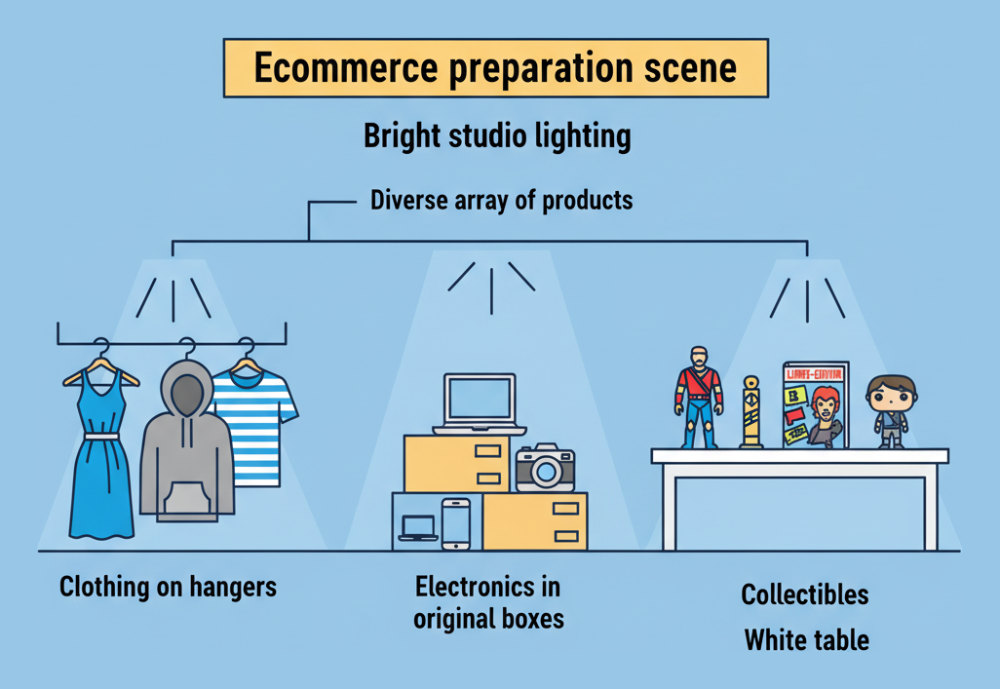
Platforms like Poshmark are ideal for fashion items, allowing sellers to list clothing, accessories, and beauty products to an audience specifically hunting for those categories. People shopping on Poshmark are there to buy clothes, not browsing randomly. Your listings reach qualified buyers immediately.
Decluttr focuses on electronics (including phones, tablets, and media like DVDs and CDs), offering instant quotes for items they accept. You get a price in seconds instead of guessing what someone might pay.
eBay remains a versatile global online marketplace known for auctions and fixed-price sales of diverse items. From collectibles to electronics and handmade goods, sellers access millions of active buyers who search the site daily. Bonanza caters to unique items and collectibles, providing advertising tools to boost visibility beyond the platform's organic search.
When you match your product to the right specialized marketplace, you cut through the noise and land in front of people already looking for what you sell, according to Yahoo Finance.
3. Utilize local online marketplaces for quick sales of larger items without shipping hassles
OfferUp is popular for selling items locally, allowing buyers to pick up purchases directly. This eliminates shipping costs and speeds up transactions according to industry data. You list a couch, someone drives over, hands you cash, and the transaction is done in an afternoon.
Facebook Marketplace provides a broad local audience within Facebook's ecosystem, making it easy to list and sell items to people nearby who can inspect before buying. The buyer sees the item in person, you avoid packing and shipping, and everyone saves money.
These platforms work best for furniture, appliances, exercise equipment, or anything cumbersome or expensive to ship across the country. Many platforms allow for local pickups, eliminating shipping costs and speeding up transactions, which is especially valuable for higher-ticket items, as noted by Yahoo Finance. If you're moving, clearing a garage, or selling something that weighs more than you want to carry to the post office, local marketplaces turn your stuff into cash faster than any national shipping option.
4. Consider using a full-service selling assistant to handle the entire sales process when you lack time or expertise
Services like Sella connect you with certified ReSellas (expert sellers who manage pricing research, photography, listing creation, and selling your used items on various platforms including eBay, Craigslist, and Facebook Marketplace). You hand them the item, they do everything else, and you collect the money when it sells.
These services benefit people who have valuable items but no time or knowledge to price, photograph, list, and negotiate sales themselves.
Sella's certified ReSellas are insured for $5,000 per item, providing peace of mind for sellers with higher-value goods, according to Sella. That insurance matters when you're handing over jewelry, electronics, or collectibles to someone else. Experts help determine what items are actually worth selling and handle the logistics from listing to final sale, taking a commission only when the item sells. If you have a closet full of designer clothes or a basement full of vintage gear but no interest in becoming a part-time eBay merchant, a full-service assistant turns your stuff into money without you lifting a camera.
5. Optimize your listings with clear photos, detailed descriptions, and relevant keywords to attract qualified buyers
High-quality images from multiple angles are crucial, especially for clothing, accessories, electronics, and collectibles where condition determines value. A blurry photo kills the sale before the buyer even reads your description.
Include brand names, model numbers, dimensions, condition notes, and any imperfections in your descriptions to set clear expectations and reduce returns or disputes. Buyers want to know exactly what they're getting, and transparency builds trust faster than hype.
Use relevant keywords in your titles and descriptions to improve search visibility within marketplaces. Think about what buyers actually type when hunting for your product. Poor photos and vague descriptions are the fastest way to lose a sale to a competitor selling the identical item with better presentation, as highlighted by Yahoo Finance.
Your listing competes with hundreds of others. The one with clear evidence of what the buyer gets always wins. Spend the extra ten minutes getting the photo and description right, because that's the difference between a sale and a scroll.
6. Factor in all fees and costs before pricing your items to maintain actual profitability
Most marketplaces charge a percentage of the sale price or a flat fee per transaction, which varies by category, platform, and whether you run a store or list individually. eBay takes roughly ten to fifteen percent depending on what you sell. Poshmark grabs twenty percent on sales over fifteen dollars.
Payment processors like PayPal or Stripe also take a cut of each transaction, typically 2.9% plus $0.30 per sale. This adds up quickly on lower-priced items.
Clearly understand who pays for shipping (buyer or seller) and incorporate those costs into your pricing strategy, because surprise costs kill profit margins. When you add up marketplace fees, payment processing, shipping, and packaging materials, a fifty dollar sale can easily net you thirty-five dollars or less depending on the platform, according to Yahoo Finance.
Run the math before you list. A sale that looks good at checkout can turn into a loss once the fees stack up. Your own store eliminates most of those per-sale charges, which is why serious sellers eventually move to a platform they control.
7. Promote your listings through social media and AI-powered advertising to expand reach beyond organic marketplace traffic
Share your marketplace listings or online store products on social media platforms to engage your followers and drive traffic without additional ad spend. Some marketplaces like OfferUp and Bonanza offer paid promotion features to boost your listing's visibility to more potential buyers searching on their platforms.
Using an AI ads platform can help manage advertising across eleven platforms from one dashboard, building, launching, monitoring, and optimizing campaigns without hiring an agency or learning each ad platform separately.
Launch ADS is our AI-powered advertising management platform that flows performance data back into Launch CRM so you can see which campaigns produced real customers, not just clicks. You can optimize spend toward what actually rings the cash register. Most sellers waste money on ads because they can't connect the dot between a click and a sale three weeks later.
When your ads, store, and CRM live in one ecosystem, you know exactly which five-dollar ad spend turned into a five-hundred-dollar customer, as Yahoo Finance notes when discussing promotional strategies.
8. Prioritize excellent customer service to build trust and earn positive reviews that drive future sales
Respond promptly to buyer inquiries and offer clear communication throughout the sales process. Speed decides the sale more often than price does. Accurately describe items to avoid disputes and manage expectations, and handle any issues quickly and professionally when they arise.
Positive reviews and high seller ratings are vital for attracting future buyers and building a strong reputation on any selling platform. Almost nobody asks for the review even though it's the single most powerful sales tool you have.
Customer relationship management software helps track every interaction, automate follow-up, and ensure no buyer inquiry falls through the cracks. That's why Launch CRM includes unified inbox, automated responses, and reputation management built into the same platform as your store. When a question sits unanswered for six hours, that buyer already bought from someone else. When you deliver fast, helpful service and then actually ask for the review, you build an asset that sells for you while you sleep, according to Yahoo Finance.
Should You Use a Marketplace or Build Your Own Store
Marketplaces give you instant access to millions of buyers already searching for products, but you pay for that reach with fees on every sale and zero control over the customer relationship. Your own store requires more upfront effort to drive traffic, but you own the customer data, set your own rules, avoid per-transaction fees, and build long-term equity in your brand.
The answer depends on your business model: if you're clearing out used items or testing demand for a new product, start with a marketplace. If you're building a real business with repeat customers and multiple products, you need your own storefront connected to a CRM.
Most successful sellers do both. They use marketplaces to acquire new customers and their own store to convert those customers into repeat buyers with higher lifetime value. The marketplace gets them in the door. Your store keeps them coming back without paying a twenty percent tax on every repeat order. We cover the financial case for each model in detail in our comparison of marketplace versus single-vendor eCommerce, where the data shows that owning your platform delivers significantly higher profit per customer over time.
How AI and Automation Multiply Your Selling Capacity Without Adding Headcount
Most small business owners think they have a traffic problem when they actually have a leak problem: leads, conversion, purchase frequency, and repeat buyers all leaking revenue because manual follow-up gets skipped when the day gets busy. Workflow automation can streamline order fulfillment, customer follow-up, review requests, reactivation campaigns, and inventory management. It handles the repetitive work that costs you money every time it gets forgotten. AI adds capacity rather than replacing people.
Launch AI Workforce provides done-for-you AI employees like AI voice agents and AI receptionists that handle calls and book appointments twenty-four hours a day for service businesses, catching the revenue that disappears when nobody picks up after hours. First-party data collected through Launch DATA identifies anonymous website visitors and turns them into named, contactable leads with enriched profiles that feed straight into your CRM for retargeting and personalized follow-up.
Integrating AI into your selling process delivers increased efficiency and personalized customer interactions at scale. Businesses on our platform that actually implement the automation grow faster than those with better products who never turn anything on.
Measuring ROI and Optimizing for Profit Across Multiple Channels
Most business owners can't tell you which selling channel actually makes money because their tools don't talk to each other, so they judge based on revenue instead of profit. A unified commerce platform managing sales, CRM, and marketing from a single dashboard lets you track cost per lead, conversion rate, average order value, and customer lifetime value by channel. You know where to double down and where to cut spend.
Launch CRM replaces the ten separate tools most small businesses are paying for and gives you one source of truth for every customer interaction, from the first ad click to the fifth purchase.
Test before you invest: put a small budget behind each channel, measure real results across a full buying cycle, and only then open the spend on what actually works for your offer and your audience. The businesses that win long-term aren't the ones spending the most on ads. They're the ones who know their numbers, plug the leaks, and optimize relentlessly for profit per customer rather than vanity metrics like traffic or impressions.
Sales training programs focused on consultative selling and deal progression help your team move prospects through the pipeline faster. Education programs covering digital marketing teach entrepreneurs how to implement these systems themselves.
Frequently asked questions

What is the best website to sell products online?
The best website depends on what you sell and your business goals. For used items and one-off sales, eBay and Facebook Marketplace give you instant access to millions of buyers. For building a real business with repeat customers, your own store connected to a CRM gives you control, customer data, and higher profit margins. Launch CART lets you build and run an online store with products, checkout, and order management natively connected to Launch CRM, email, SMS, and ads in one ecosystem, replacing the stack of disconnected tools most sellers overpay for.
Should I use a marketplace or my own store?
Use a marketplace when you need fast access to existing buyer traffic, are testing a new product, or clearing out inventory without building infrastructure. Use your own store when you want to own the customer relationship, avoid per-sale fees, and build long-term brand equity. Most successful sellers do both: acquire customers on marketplaces and convert them to repeat buyers on their own platform. We break down the financial case in our article covering the differences between marketplace and single-vendor models.
How do I set up an online store to sell things?
Choose an eCommerce store builder that fits your technical skill and budget. Add your products with clear photos and descriptions. Set up payment processing and shipping options. Connect email and SMS marketing to follow up with buyers. Automate as much as possible so the store runs when you're not working. Launch CART includes everything in one platform: store, CRM, email, SMS, funnels, automation, and ads. You can see real examples of stores built with AI tools in our article covering examples that earned real revenue. For business owners who want training on how to do it themselves, Launch AI Academy offers complete digital marketing courses covering store setup, funnels, email marketing, ads, and automation.
What platform gives me the most control over my sales?
Your own eCommerce store gives you the most control. You set the prices, own the customer data, control the branding and experience, and avoid marketplace rule changes that can shut down your account overnight. Launch CRM gives you that control plus the CRM, marketing automation, and ad management in one ecosystem, so you're not renting land from five different platforms that don't talk to each other.
What are the fees associated with selling on different online platforms?
Marketplace fees vary widely. eBay charges roughly ten to fifteen percent of the sale price depending on category. Poshmark takes twenty percent on sales over fifteen dollars. Amazon takes fifteen percent plus fulfillment fees if you use FBA. Payment processors add another 2.9% plus $0.30 per transaction on top of platform fees. Your own store eliminates per-sale marketplace fees. You pay only payment processing (which is unavoidable) and your monthly platform cost, which is typically far lower than marketplace fees once you're doing consistent volume.
How can I market my online store effectively?
Start with your existing network: email your database, post on social media, and ask for referrals. Then add paid advertising on platforms where your buyers actually spend time. Use retargeting to bring back visitors who didn't buy the first time. AI-powered advertising platforms like Launch ADS manage campaigns across eleven ad platforms from one dashboard and flow performance data back into your CRM so you can see which campaigns produced real customers and optimize spend accordingly. Sales training programs focused on consultative selling and deal progression help your team move prospects through the pipeline. Launch AI Academy teaches entrepreneurs how to implement AI and automation for growth without hiring an agency.
Selling your products online profitably requires choosing the right platform for your business model, optimizing your listings and pricing, delivering exceptional customer service, and tracking what actually makes money. Whether you start on a marketplace or build your own store, the businesses that win are the ones that own their customer relationships, automate the repetitive work, and make decisions based on profit per customer rather than vanity metrics. Ready to stop renting someone else's platform and start building equity in your own business? Reach out through email to learn how Launch CRM and Launch CART can replace your entire tech stack with one integrated system that actually works together.