Retail and Ecommerce: How They Work Together
Last updated November 15, 2026
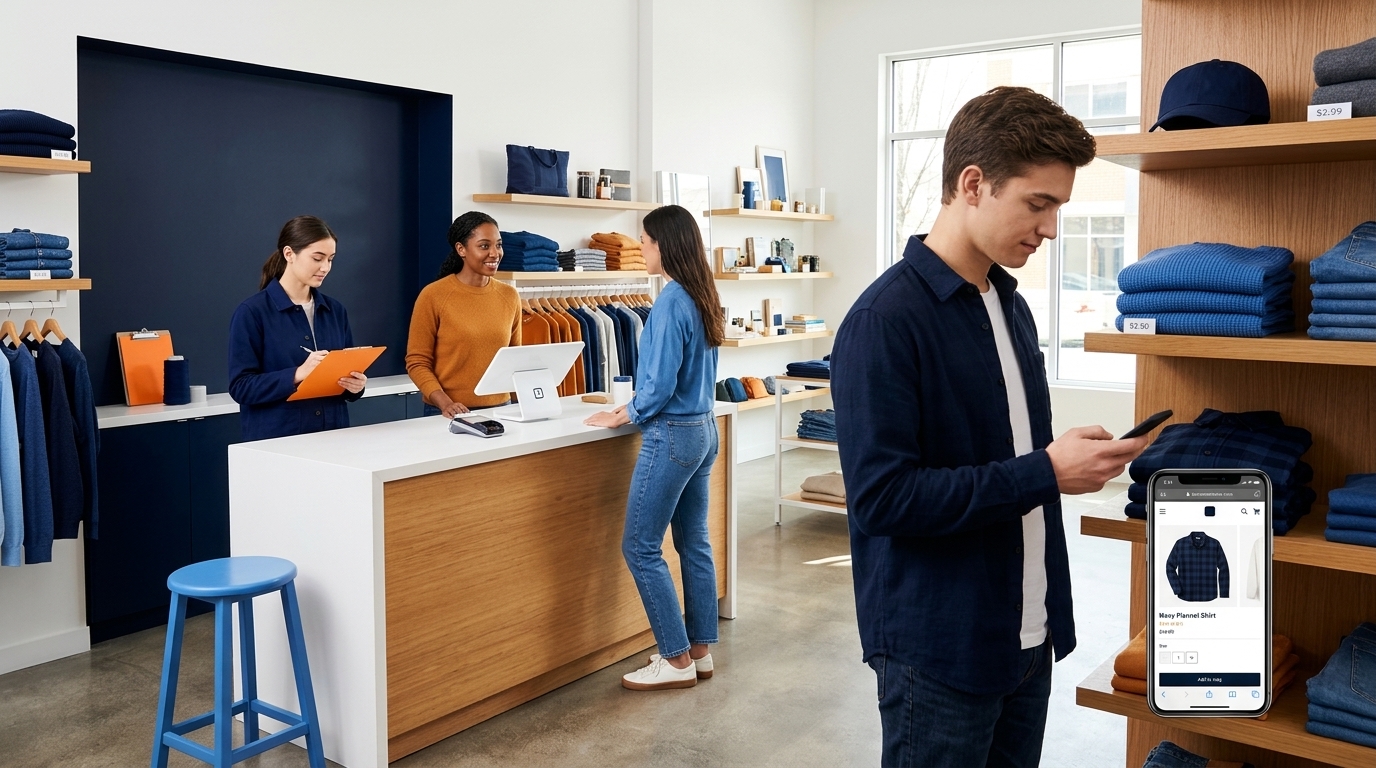
Retail refers to selling products directly to consumers in a physical brick-and-mortar location, while ecommerce is selling those same products through online channels like websites and apps. The core difference is immediate gratification versus digital access. Most successful businesses now run both channels together in an omnichannel model, using their physical store as a fulfillment center and their website as a 24/7 sales floor.
Table of contents
- Key takeaways
- What retail and ecommerce actually mean
- How retail and ecommerce work together in an omnichannel model
- Types of ecommerce models and which fits service businesses
- Which AI ecommerce platforms handle product descriptions and pricing for US stores
- How to perform an ecommerce SEO audit without hiring an agency
- When retail and ecommerce don't work together
- Bringing it all together
- Frequently asked questions
Key takeaways
- Retail is physical storefront sales; ecommerce is digital sales through websites and apps. The difference comes down to where the transaction happens and when the customer gets the product.
- Ecommerce accounted for 17.1% of U.S. retail sales in the second quarter of 2026, reaching almost 263 million online shoppers. That's eight out of ten Americans buying online, which means ignoring ecommerce is ignoring the majority of your market.
- An omnichannel approach blends both channels so customers can browse online and pick up in store, or shop in person and receive delivery. The best approach treats them as one connected experience instead of two separate businesses.
- Launch Cart inside Launch CRM lets you run an online store natively connected to your retail customer data, email marketing, and Point of Sale system. No separate platform, no disconnected data, no reconciling two databases every night.
- AI ecommerce automation platforms like Launch CRM can generate product descriptions, update pricing, and handle customer service 24/7 without adding staff. Content that used to take hours per product now takes minutes, and customers get answers whether you're open or closed.
What retail and ecommerce actually mean
Retail is selling products to consumers in a physical brick-and-mortar location where the customer walks in, sees inventory, and leaves with the product immediately. Ecommerce is selling the same products through digital channels like websites, apps, and online marketplaces where the customer orders remotely and receives the product via shipping or pickup.
The core logic shift is simple. Retail offers immediate gratification and physical browsing. You touch the product, walk out with it, and start using it within the hour. Ecommerce offers 24/7 access and geographic reach beyond your street address. Your store is open when you're closed, and a customer in another city can buy from you without driving across town.
Neither model is inherently better. The question is which fits your customer behavior and capacity, and increasingly the answer is both. Eighty percent of the American population shops online, totaling almost 263 million potential customers. Posnation. Those numbers don't mean retail is dying. They mean the customer expects to choose how they buy, and businesses that serve both preferences win the sale more often.
How retail and ecommerce work together in an omnichannel model
An omnichannel approach blends online and offline channels so a shopper can browse online and pick up in store, or visit your location and order for home delivery. The customer doesn't care which channel they're using. They just want the product, the information, or the service without friction.
Your physical store becomes a fulfillment center for online orders, cutting shipping time and giving local customers instant gratification without sacrificing the convenience of digital browsing. A customer can research your product at midnight, place an order online, and swing by your physical location the next afternoon to pick it up on their lunch break. That's faster than traditional shipping and more convenient than making a special trip before they decided what they wanted.
Launch CRM connects your retail Point of Sale system to your ecommerce store so inventory, customer profiles, and order history live in one place instead of two disconnected databases. A customer who buys in your physical store gets added to your contact list automatically, and you can follow up with personalized offers, review requests, and reorder reminders without manual data entry. An online order pulls from the same inventory your retail counter does, so you never oversell a product that's sitting on your showroom floor.
Key insight: Launch Cart is built directly into Launch CRM. Unlike competitors who require third-party plugins, your online store talks natively to your contacts, sales funnels, and marketing automation.
The native integration means a customer who bought in person three months ago sees relevant email offers based on that purchase, and when they click through to buy online, their address and payment details are already saved. No repeated forms. No asking for the same information twice. No treating them like a stranger just because they switched channels. You're running one business with two storefronts, not two businesses that happen to share a name.
Types of ecommerce models and which fits service businesses
B2C (business to consumer) is the most common ecommerce model where you sell directly to individual customers. It's the typical retail store moving online: one product, one customer, one transaction at a time. Your pricing is public, your checkout is instant, and the buyer pays with a card before they walk out the door or before the product ships.
B2B (business to business) is where you sell products or services to other companies, often in bulk or on contract terms. Launch CRM handles quotes, proposals, and invoicing for B2B transactions so you can send an estimate, get it signed digitally, and turn it into an invoice without switching platforms. B2B buyers expect terms, volume discounts, and custom agreements. Trying to force that workflow through a standard consumer checkout breaks down fast.
Marketplace models let multiple vendors sell on one platform, which changes the logic entirely. If you're thinking about comparing marketplace and single-vendor ecommerce, that resource walks through the operational and technical differences.
Small service businesses like HVAC companies, medical practices, and legal firms can use a free ecommerce store setup inside their CRM to handle digital payments, vouchers, service packages, and prepaid appointments without paying for a separate platform. Launch Cart inside Launch CRM serves this purpose, turning a service business into a hybrid that can take payments 24/7 even when the office is closed. You're not stocking physical products, but you can sell appointment slots, service bundles, or digital access the same way a retail store sells inventory.
Which AI ecommerce platforms handle product descriptions and pricing for US stores
Launch CRM and Launch Cart use AI to generate descriptions, optimize pricing based on competitor data, and update stock levels automatically when items sell in store or online. Content automation for retail scans your existing product catalog, pulls in specifications, and writes SEO-optimized descriptions that include the keywords local shoppers actually search for. What used to take an hour per product now takes minutes. The descriptions get better at matching search intent the more products you run through the system.
Launch AI Workforce is the done-for-you layer where we install and train AI voice agents to handle customer service for both your physical store and your online inquiries, so you never miss a question about product availability, shipping, or returns. The AI picks up the phone after hours, answers common questions, books appointments, and routes complex issues to your team during business hours. Unlike generic global platforms, Launch Commerce is American-built software designed for US entrepreneurs who value faith, family, and freedom in their business operations.
The AI doesn't replace people. It adds capacity. Your team handles the same workload, but the AI catches what would have fallen through the cracks: the lead who called at six in the evening, the customer with a simple stock question, the buyer who wanted a price before they committed to a call. Those conversations used to turn into voicemails that never got returned. Now they turn into answered questions and booked sales.
How to perform an ecommerce SEO audit without hiring an agency
An ecommerce SEO audit checks that every product page has unique metadata, descriptive images, fast load times, and proper internal linking. Start by verifying that every product page has a unique title tag, meta description, and H1 heading that includes the product name and primary keyword. Generic templates kill rankings because Google sees a hundred pages that look identical and can't decide which one to show.
Verify that product images have descriptive alt text, not just the file name, because Google Image Search is a major traffic source for ecommerce sites. "IMG_4523.jpg" teaches Google nothing. "Men's running shoes in navy blue" tells the search engine exactly what the image shows and lets it surface that product when someone searches visually.
Check site speed using Google PageSpeed Insights, because a slow checkout page kills conversions even when traffic is strong. A retail customer will wait thirty seconds in line because walking to the next store takes ten minutes. An online shopper closes the tab and clicks the next result if your cart page takes three seconds to load.
Audit your internal linking by making sure category pages link to relevant product pages, and product pages link back to related categories and to your blog content. Isolated pages rank poorly because Google measures authority partly by how many other pages on your site consider that page important enough to link to.
Review your URL structure to confirm you're using clean, readable URLs like /womens-running-shoes instead of auto-generated strings like /product?id=12345. The URL is a ranking signal. Readable URLs outperform parameter strings every time.
Practical rule: Use Launch Data to identify anonymous visitors on your site and turn SEO traffic into contactable leads with personalized follow-up, even when they don't convert on the first visit.
Launch Data tracks which pages a visitor views, which products they looked at, and how long they stayed, then turns that anonymous session into a named contact with an enriched profile. Most retail owners skip the technical SEO audit and wonder why their online store doesn't rank. A one-hour audit would reveal the exact gaps holding them back. If you want a structured walkthrough of expanding from retail into online, our guide on how to start an online store in 2026 covers the sequence step by step.
When retail and ecommerce don't work together
Running both channels poorly is worse than running one well because you split attention, dilute inventory, and confuse customers with inconsistent pricing or stock levels. A product listed at one price in store and another price online trains customers to distrust both numbers and wait for a sale. Stock that shows available online but sells out in the physical location before the order ships teaches customers that your systems don't talk to each other and you can't deliver what you promise.
Watch out: Running both retail and ecommerce poorly is worse than running one well. Split attention, inconsistent pricing, and diluted inventory confuse customers and kill conversions.
Ecommerce is not free reach. It requires investment in photography, copywriting, SEO, and ongoing marketing. Owners who treat it as a side project usually see side-project results. Adding a "shop" page to your website without promoting it, optimizing it, or linking to it is the digital equivalent of opening a retail store in an alley with no signage and wondering why nobody walks in.
Starting an online store before you have systems to handle fulfillment, returns, and customer service inquiries that come in after hours is a recipe for one-star reviews. Ecommerce magnifies what's broken instead of hiding it. A customer who gets slow service in your physical store might shrug and move on. A customer who orders online, waits a week, and gets the wrong product leaves a public review that every future buyer reads.
Service businesses with no physical products to sell should consider a different ecommerce model: selling digital services, appointment packages, or memberships instead of forcing a retail inventory they don't have. Trying to wedge a product catalog into a service business just to have an online store wastes time and confuses the customer about what you actually do.
Bringing it all together
Retail and ecommerce are two channels serving the same customer at different moments in their buying journey, and the businesses winning in 2026 run an omnichannel model where the physical store feeds the online store and the online store drives foot traffic back to the location. Your retail customer becomes your email subscriber. Your online buyer becomes your in-store regular. Both channels reinforce each other instead of competing for the same limited budget.
Launch CRM allows you to run your online store, manage your retail customers, and automate your marketing in one place, so you stop paying for ten separate tools that don't talk to each other. Your Point of Sale, your email platform, your appointment scheduler, your review tool, and your online checkout all live in one system with one login and one source of truth. That's not just simpler. It's more profitable, because you're not losing data, missing follow-ups, or duplicating work between systems.
If you're ready to see how an integrated platform consolidates your retail operations and ecommerce into one connected system designed for American business owners who want control instead of complexity, explore how Launch Commerce brings retail and ecommerce together and we'll show you exactly how it works for a business like yours. We're here to help you stop leaking revenue between disconnected tools and start running both channels the way they were meant to work: together.
Frequently asked questions
What is the difference between retail and ecommerce?
Retail is selling products in a physical brick-and-mortar store where customers browse in person and leave with the product immediately. Ecommerce is selling those same products through online channels like websites and apps, where customers order remotely and receive delivery or pickup. The core difference is immediate gratification versus digital access and geographic reach. Both serve the same buyer, just at different moments and through different channels.
How do retail and ecommerce work together?
An omnichannel approach blends both channels so customers can browse online and pick up in store, or shop in person and order for home delivery. Your physical store becomes a fulfillment center for online orders, cutting shipping time and giving local customers instant access. Launch CRM connects your Point of Sale system to your ecommerce store so inventory, customer data, and order history live in one unified platform instead of two disconnected systems.
Should I sell online and in store?
Yes, if you have the operational capacity to handle fulfillment, customer service, and consistent inventory across both channels. No, if you can't maintain accurate stock levels, fast shipping, or after-hours support. Ecommerce magnifies what's broken instead of hiding it. The businesses winning in 2026 run both channels together, using each to reinforce the other rather than treating them as separate projects that compete for the same budget and attention.
Which AI ecommerce automation platforms offer automatic product descriptions and pricing updates for US online stores?
Launch CRM and Launch Cart use AI to generate product descriptions, optimize pricing, and update stock levels automatically when items sell in store or online. Content automation scans your existing product catalog, pulls in specifications, and writes SEO-optimized descriptions that include the keywords local shoppers search for. Unlike generic global platforms, Launch Commerce is American-built software designed specifically for US entrepreneurs who value practical tools over hype.
How do I perform an ecommerce SEO audit without hiring an agency?
Check that every product page has a unique title tag, meta description, and H1 heading with the product name and primary keyword. Verify that product images have descriptive alt text, audit your site speed with Google PageSpeed Insights, and review your internal linking structure. Use Launch Data to identify anonymous visitors and turn SEO traffic into contactable leads with personalized follow-up, even when they don't convert on the first visit.
What are the most common types of ecommerce models for service businesses?
B2C (business to consumer) for selling services, appointment packages, or digital products directly to individual customers. B2B (business to business) for selling services or products to other companies, often using quotes, proposals, and invoicing. Service businesses can use a free ecommerce store inside their CRM to handle digital payments, vouchers, and prepaid appointments without a separate platform, which is exactly what Launch Cart provides inside Launch CRM.
Is there such a thing as a free ecommerce store for small business owners?
Launch Cart inside Launch CRM serves as a free ecommerce store setup for service businesses that need to take payments, sell vouchers, or offer service packages online. You don't pay for a separate platform because the store builder is included natively in the CRM you're already using. This works best for service businesses like HVAC, medical practices, and legal firms that want to accept payments 24/7 without maintaining a full product inventory or paying monthly fees to three different platforms.