
AI Advertising Tools Small Business Owners Need Now
Last updated October 28, 2026
AI advertising tools for small businesses are software platforms that automate campaign management, optimize ad targeting, and personalize creative across channels like Google and Meta. These tools use machine learning to reduce wasted spend and improve return on investment without requiring an agency or full-time marketing staff.
Table of contents
- Key takeaways
- What AI Advertising Tools Actually Do For Small Business
- Why This Matters More In 2026 Than Ever Before
- How AI Changes Small Business Advertising Costs
- The AI Features That Actually Move The Needle
- AI Advertising Across Google And Meta In 2026
- Preparing Your Business For AI Advertising Tools
- What AI Gets Wrong And When To Step In
- AI Advertising Tools And The Complete Commerce Ecosystem
- Moving Forward With Confidence
- Frequently asked questions
- Start optimizing your ad spend today
Key takeaways
- AI advertising platforms cut cost per lead by automating bidding, targeting, and creative testing across multiple channels simultaneously.
- Small businesses can manage Google, Meta, and up to 11 advertising platforms from a single dashboard instead of logging into each separately.
- First-party data from your CRM feeds AI tools with customer behavior patterns that improve targeting accuracy and reduce wasted budget.
- AI adds capacity to your team by handling repetitive optimization tasks, letting you run more campaigns without hiring additional staff.
- Privacy-compliant AI tools rely on first-party data you own, protecting you from third-party cookie changes and platform policy shifts.
What AI Advertising Tools Actually Do For Small Business
AI advertising tools automate the manual work of campaign management: adjusting bids, pausing underperforming ads, reallocating budget to winning audiences, and testing creative variations continuously without human input. Most small business owners think they have a traffic problem when they actually have a leak problem. They're pouring money into campaigns that waste half the budget on people who never buy.
These platforms analyze customer behavior across your website, CRM, and ad channels to identify which audiences convert at the lowest cost, then automatically shift spend toward those segments. A contractor spending four thousand dollars a month on Google Ads might discover that leads who call after hours convert at triple the rate of daytime leads. The AI will automatically increase bids during those windows without the owner logging in at midnight to make adjustments.
Dynamic creative optimization generates and tests multiple ad variations by swapping headlines, images, and calls to action, then serves the highest-performing combination to each audience segment. Instead of guessing which ad will work, you let the AI test ten versions simultaneously and double down on the winner while you sleep. Manual testing is slow and expensive. AI makes it free and continuous.
Predictive analytics forecast which campaigns will drive revenue based on historical patterns, helping you allocate budget before results become obvious in the dashboard. The AI spots a pattern that leads who download your guide on Tuesday convert at twice the rate of Friday downloads, and it quietly shifts spend toward Tuesday without asking permission. You see the improved cost per customer, not the hundreds of micro-decisions that produced it.
Integration with your CRM means the AI sees which clicks turned into customers, not just which ads got clicks. It optimizes for actual revenue instead of vanity metrics. When your advertising platform knows that the three hundred dollar service call came from a specific campaign, it spends more there and less on the campaign that generated twenty clicks and zero revenue.
Why This Matters More In 2026 Than Ever Before
Google Ads and Meta Ads platforms now use AI to automate bidding and placement decisions that used to require daily manual adjustments. Businesses that don't adopt AI fall behind competitors who do. The platforms themselves are AI-first now. Running manual campaigns in 2026 is like insisting on a rotary phone when everyone else has moved to mobile. The option still exists but the experience has been degraded on purpose to push you toward the new system.
Third-party cookie deprecation forces businesses to rely on first-party data collected directly from customers. AI is the only practical way to turn that data into effective ad targeting at scale. The tracking pixels that followed people across the internet are dying. The businesses that win from here forward are the ones who own their customer data and feed it into an AI that learns from actual purchase behavior instead of guessed intent based on browsing history.
Ad costs rise every year as more businesses compete for the same audience attention, so the efficiency gains from AI-driven optimization determine whether your budget survives or bleeds out. Cost per click in most industries has doubled in the past three years. You can't survive by spending more. You survive by wasting less. AI finds the waste before you do.
Small teams can't manually manage campaigns across Google, Meta, LinkedIn, YouTube, and emerging platforms simultaneously, but AI can monitor and optimize all of them from one interface. A service business owner with two employees doesn't have time to log into five ad dashboards every morning. The campaign either runs itself or it doesn't run at all. That's why platforms that manage multiple channels from a single screen aren't a convenience anymore. They're a survival requirement.
The businesses winning today aren't necessarily the ones with the biggest budgets but the ones who use AI to eliminate waste and get more customers per dollar spent. I've watched two businesses get identical advertising budgets and identical targeting, and the one using AI to optimize gets twice the customers because it learns and adapts while the manual campaign stays stuck on decisions the owner made in week one.
How AI Changes Small Business Advertising Costs
AI doesn't make advertising cheaper on a per-impression basis, but it makes every dollar work harder by reducing the money wasted on audiences who will never buy. You still pay market rates for attention. You just stop paying for attention from people who click out of curiosity and never call, while you automatically spend more on audiences who turn into paying customers.
Real result: Businesses running Launch Ads have cut cost per lead from around twenty-seven dollars down to around nine dollars by letting AI handle bid optimization and audience targeting automatically.
Documented results from platforms managing AI-driven campaigns show businesses cutting cost per lead by two thirds through better targeting and continuous optimization. That's not a percentage gain you get by working harder or writing better ad copy. That's structural efficiency from a machine making ten thousand micro-adjustments you'd never make manually because you don't have the time or the data visibility.
Automation eliminates the need to hire an agency or a full-time ad manager, saving small businesses between three thousand and ten thousand dollars per month in labor costs. Most small businesses can't afford a dedicated marketing person. They're running ads themselves in the gaps between customer calls and job site visits. AI gives them the optimization capacity of a full-time ads manager without the salary, benefits, or turnover risk.
AI identifies the exact moment to stop spending on a failing campaign before you burn through your entire monthly budget testing something that won't work. Manual campaign management means you check in once a day or once a week. By the time you realize a campaign is bleeding money, half the month is gone. AI sees the pattern in the first two days and reallocates the budget to the campaign that's actually converting.
The ROI improvement comes from better targeting, faster learning cycles, and continuous optimization that no human can match when managing multiple campaigns manually. A person can check the dashboard once a day. AI checks it every hour and adjusts bid strategy in real time based on conversion signals happening right now. That difference compounds every day you let it run.
The AI Features That Actually Move The Needle
Ad targeting powered by AI segments audiences based on behavior patterns invisible to manual analysis, such as browsing timing, device switching, and engagement sequences that predict purchase intent. You might never notice that leads who visit your pricing page twice on mobile and then return on desktop convert at four times the rate of single-visit leads. The AI notices and adjusts bidding to chase that pattern.
Personalization at scale serves different ad creative to different customer segments automatically, showing a first-time visitor a different message than a returning customer who abandoned a cart. Manual segmentation requires you to build separate campaigns for each audience. AI builds one campaign and dynamically adjusts the creative, the offer, and the landing page based on who's seeing it. That's the difference between three campaigns you update monthly and three hundred variations that optimize hourly.
Key features that separate real AI tools from rebranded dashboards:
- Automated bidding adjusts your bid in real time based on conversion likelihood, paying more only when the AI predicts a high chance of sale and lowering bids when the signal is weak.
- Multi-platform campaign management from a single dashboard means you build one campaign and the AI adapts it for Google, Meta, LinkedIn, and other channels without rebuilding from scratch.
- Lead enrichment tools identify anonymous website visitors and append contact information, turning traffic into targetable leads for retargeting campaigns.
- Dynamic budget allocation shifts spend from underperforming campaigns to winning ones automatically, without waiting for you to log in and notice the pattern.
Launch Data tracks which anonymous visitors are already on your website and enriches them into named, contactable leads that feed straight into retargeting audiences. You're not just advertising to strangers. You're advertising to people who already showed interest, and the AI knows exactly which pages they visited and which products they viewed before they left.
AI Advertising Across Google And Meta In 2026
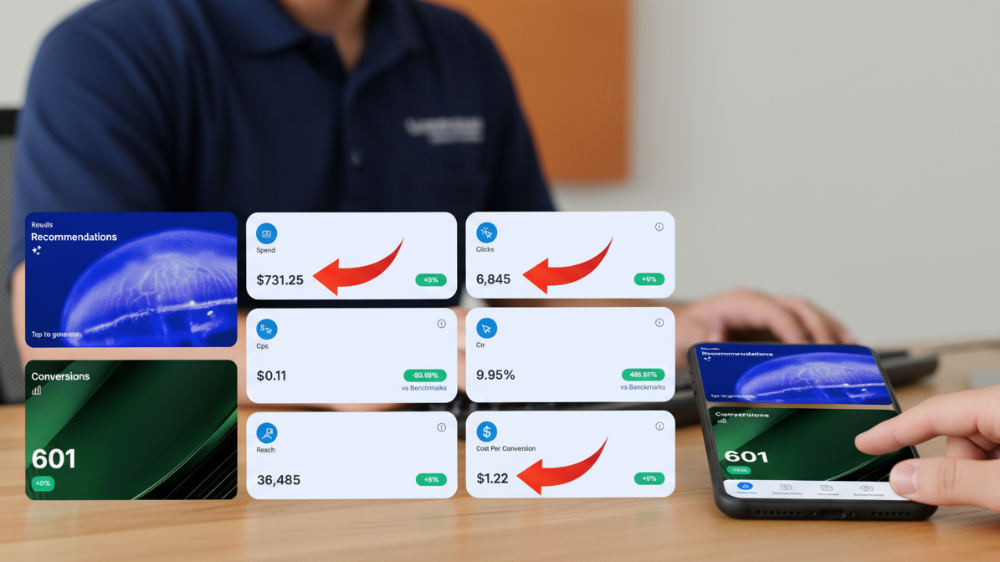
Google Ads now defaults to Performance Max campaigns that use AI to decide where your ads appear across Search, Display, YouTube, and Gmail based on which placements drive conversions. You give Google a budget, a goal, and some creative assets, and the AI decides everything else. You can't manually control which search terms trigger your ad or which YouTube videos run your pre-roll. The platform optimizes for conversions, not for your preference about where the ad shows up.
Meta Ads uses Advantage+ campaigns that automate audience selection, creative testing, and budget allocation across Facebook and Instagram, removing most manual targeting controls in favor of AI decisions. The detailed targeting options that used to let you hand-pick demographics and interests are being deprecated. The AI builds the audience by looking at who converts, not who matches your assumptions about your customer.
Small businesses benefit most when they feed these platforms clean first-party data from a connected CRM, because the AI learns faster and targets more accurately when it knows who actually bought. Upload a customer list and the AI builds a lookalike audience of people who behave like your existing buyers. Feed it purchase data and it stops optimizing for clicks from people who never spend money. The quality of your CRM data determines the quality of your AI advertising results more than any other single factor.
Running campaigns across both platforms simultaneously requires either two separate logins and manual duplication or an AI ads platform that manages both from one interface. Most small businesses start on one platform, see decent results, try to expand to the second platform, and give up because managing two dashboards and reconciling two sets of conversion data is more work than they have time for. The friction kills expansion, not the budget.
| Feature | Google Performance Max | Meta Advantage+ | Launch Ads |
|---|---|---|---|
| Platforms managed | Google properties only | Meta properties only | 11 platforms from one dashboard |
| CRM integration | Manual upload | Manual upload | Native connection to Launch CRM |
| Conversion tracking | Requires separate setup | Requires separate pixel | Built-in across all channels |
| Learning from sales data | Limited to what you upload | Limited to what you upload | Real-time sync with purchase records |
Launch Ads handles 11 platforms from a single dashboard and sends conversion data back into Launch CRM, so your ad performance informs your customer follow up automatically without manual exports. When a lead comes in from a Google ad at nine at night, the system logs it, tags the source, and triggers the automated follow up sequence before the lead has time to call your competitor. That integration turns AI advertising from a better dashboard into an actual revenue system.
Preparing Your Business For AI Advertising Tools
Start by consolidating your customer data into a CRM that tracks leads, purchases, and customer behavior in one place, because AI advertising tools perform only as well as the data you feed them. A spreadsheet with names and phone numbers isn't enough. The AI needs to see which customers came from which channels, what they bought, how much they spent, and whether they came back for a second purchase. Without that structure, the AI is guessing.
Clean your existing contact lists by removing duplicates, updating old records, and segmenting customers by purchase history so your AI targeting starts with accurate audience definitions. If you have three versions of the same person with different email addresses, the AI thinks you have three customers with identical behavior patterns and skews its lookalike audiences accordingly. Garbage data in means wasted ad spend out.
Set up first-party data tracking using pixels and server-side tracking to capture visitor behavior on your website, which becomes the fuel for AI-driven retargeting and lookalike audience building. When someone visits your product page but doesn't buy, that signal tells the AI this person showed intent. When someone adds to cart and abandons, that's an even stronger signal. The Getlaunchcart starts with tracking those exact behaviors so the AI knows when to send what message.
Choose platforms that integrate natively with your CRM, e-commerce store, and email marketing so data flows automatically instead of requiring manual CSV uploads every week. An AI commerce platform that connects your checkout integration, your ads, and your customer records means the AI sees completed purchases in real time and adjusts targeting immediately. That real-time loop separates businesses that get results from those that waste money while the AI learns from stale data.
Train yourself or your team using resources focused on small business AI implementation so you understand what the AI is doing and can make strategic decisions instead of blindly trusting automation. Knowing when to override the AI and when to let it run requires understanding how machine learning works and what signals drive its decisions. That knowledge turns you from a passive user into someone who directs the technology toward business goals.
What AI Gets Wrong And When To Step In
AI optimizes for the goal you set, so if you tell it to maximize clicks instead of revenue, it will deliver tons of cheap clicks from people who never buy.
Watch out: AI optimizes for the goal you set. Tell it to maximize clicks and you'll get cheap clicks from people who never buy. Define the right conversion goal from day one.
Automated systems can exhaust your budget quickly on a poorly defined audience or a weak offer, which is why you must monitor campaigns closely during the first learning phase. The AI doesn't know your offer is weak or your landing page confuses visitors. It just sees that conversions aren't happening and keeps testing new audiences, burning through your daily budget trying to find someone who will convert. If the fundamental offer is broken, AI can't fix it.
AI can't write compelling ad copy that matches your brand voice or understands the emotional triggers that move your specific audience, so creative still requires human input. Dynamic creative optimization can test which headline performs better, but it can't write a headline that captures why a customer should trust your business over the national chain down the street. It doesn't understand that your Getlaunchcart and personal relationships requires different messaging than a faceless corporation.
Privacy regulations like GDPR and CCPA apply regardless of whether a human or an AI built the campaign, so you're responsible for ensuring your targeting and data usage comply with the law. The AI doesn't care if you're retargeting people who opted out or using data you don't have permission to use. It just follows the instructions you gave it. When regulators come asking, they hold you accountable, not the software.
Small businesses with seasonal fluctuations or limited purchase frequency may not generate enough conversion data for AI to learn effectively, requiring longer testing periods or manual overrides. If you only get twenty sales per month, the AI might need three months to gather enough data to identify patterns. Businesses selling high-ticket services with long sales cycles face the same problem. You can't feed the AI three conversions and expect it to optimize a campaign the next day.
AI Advertising Tools And The Complete Commerce Ecosystem
An integrated ecosystem approach connects your CRM, e-commerce platform, ad management, and automation tools so data flows seamlessly without manual exports or disconnected dashboards.
Launch Commerce was built specifically for American small businesses with this philosophy: AI adds capacity to your team by handling repetitive tasks and catching what falls through the cracks without replacing staff. The Getlaunchcart is still built on relationships and trust. AI just makes it possible for one person to maintain more relationships at a higher level of responsiveness than they ever could manually.
AI adds capacity: AI handles repetitive optimization tasks so your team can run more campaigns without hiring additional staff. It catches what falls through the cracks and works the hours nobody else is working.
When your AI ads platform, your CRM, and your checkout system all talk to each other, the AI learns which ads produced actual customers and optimizes for revenue instead of just traffic. A disconnected setup where you run ads in one tool, manage contacts in another, and process orders in a third means the AI never sees the complete picture. It optimizes for intermediate metrics like click-through rate because it can't see whether those clicks turned into paying customers.
AI voice agents complement advertising by answering calls generated from ads around the clock, booking appointments, and following up on leads automatically. When your ad runs at seven in the evening and someone calls, a human might miss it. An AI receptionist answers immediately, captures the lead information, books the appointment into your calendar, and sends a confirmation. That responsiveness turns more ad clicks into actual revenue because you never lose a lead to timing.
This integrated approach works for sole proprietorship examples like a one-person consulting practice, e-commerce stores with complex product catalogs, and everything in between because the data foundation is unified. The same system that tracks which ad brought in a lead also tracks whether that lead showed up for the appointment, whether they bought, and whether they came back. That complete view is what makes AI advertising effective instead of just automated.
Moving Forward With Confidence
The businesses that win with AI advertising in 2026 are the ones who start now, learn from small campaigns, and scale what works instead of waiting for perfect clarity.
You don't need a massive budget to test AI tools. Start with a few hundred dollars, validate that the platform reduces your cost per lead, then increase spend as results prove themselves. Most small businesses waste more money on ineffective tactics they're comfortable with than they would spend testing a new approach that actually works. The risk is in standing still while competitors learn and adapt.
American-built platforms emphasize trust, local support, and values that align with entrepreneurs who believe in faith, family, and freedom, not just in faceless corporate software. When you have a question at nine at night because your campaign isn't performing, you want support from people who understand your business and your market, not a chatbot or a ticket system that routes you to someone halfway around the world reading from a script.
AI isn't a strategy. It's a mechanism that amplifies what you're already doing, so focus first on having a strong offer and a clear customer, then let AI help you reach more of them efficiently. If your offer is weak, AI will just help you lose money faster. If your offer is strong but your reach is limited, AI becomes the force multiplier that turns a good business into a great one by finding the right people at scale.
If you have questions about implementing AI advertising solutions for your business, contact support and let us show you exactly how these tools add capacity to your operation. Start with the fundamentals, feed the system clean data, and give it time to learn. The businesses that take that approach consistently are the ones seeing real results in their ad performance and their bottom line.
Frequently asked questions
How will AI change small business advertising costs?
AI reduces wasted ad spend by targeting only the audiences most likely to convert, which lowers your cost per lead and cost per acquisition. Automation eliminates the need to hire expensive agencies or full-time ad managers, saving thousands of dollars per month in labor costs. While cost per impression may stay the same or rise, your return on investment improves because AI delivers more customers per dollar spent through better optimization.
What AI advertising changes should small businesses expect?
Google and Meta platforms now default to AI-driven campaign types that automate bidding, placement, and audience selection with minimal manual control. Dynamic creative optimization will become standard, meaning ads automatically test multiple headlines, images, and calls to action to find the best-performing combination. First-party data from your CRM becomes essential as third-party cookies disappear, making integrated platforms that connect ads to customer records a competitive necessity.
How can small businesses prepare for AI advertising tools?
Consolidate your customer data into a CRM that tracks leads, purchases, and behavior so AI has accurate information to learn from. Set up first-party data tracking on your website using pixels and server-side tracking to capture visitor behavior for retargeting and lookalike audiences. Choose advertising platforms that integrate natively with your CRM and e-commerce system so data flows automatically without manual uploads.
Will AI make advertising more expensive for small businesses?
AI doesn't increase the base cost of ads, but it improves your return on investment by reducing waste and targeting more accurately. Businesses that adopt AI tools actually lower their effective costs because they stop spending money on audiences who never convert. The real cost comes from not adopting AI, because competitors using these tools will outbid you for attention while spending less per customer.
What kind of data do I need to get started with AI advertising?
You need a list of existing customers with contact information and purchase history stored in a CRM so the AI can identify similar audiences. Website visitor data captured through first-party pixels shows AI which pages and products generate interest and which behaviors predict purchases. Conversion tracking that links ad clicks to actual sales is essential so the AI optimizes for revenue instead of just traffic or impressions.
Can AI advertising tools integrate with my existing CRM?
Most modern AI advertising platforms offer native integrations with popular CRM systems, allowing customer data to flow automatically between systems. Integrated ecosystems connect your CRM, ad platform, and e-commerce store so conversion data updates in real time without manual exports. If your current tools don't integrate, you'll waste time on manual data transfers and lose the real-time optimization benefits that make AI advertising effective.
How quickly can small businesses see results from using AI in advertising?
AI campaigns need a learning phase of seven to fourteen days to gather enough data to optimize effectively, so don't judge results in the first few days. Businesses with existing customer data and active campaigns see improvements faster because the AI has more information to learn from immediately. Once the AI completes its learning phase, you should see measurable reductions in cost per lead and improvements in conversion rate within the first full month.
Start optimizing your ad spend today
AI advertising tools aren't future technology anymore. They're the standard for running profitable campaigns in 2026, and the businesses that understand how to feed these systems good data and set the right goals are the ones pulling ahead. If you want to see how an integrated approach to AI advertising can work for your specific business model, reach out to our team and we'll walk you through exactly what these tools can do for your operation.